Portrait of Alex Odeh
Jamal Rayyis is a New York-based journalist who specializes in the intersection of gastronomy, culture, and politics. His interest in politics was nurtured by his parents who were active in Arab community organizing in Los Angeles. Jamal’s father was both a friend and collaborator to Alex Odeh. Jamal has continued this legacy being active in New York and national Arab circles, including being a founding board member of the Arab and Middle Eastern Journalists Association (AMEJA), which represents over 400 MENA-heritage journalists in North America and abroad.
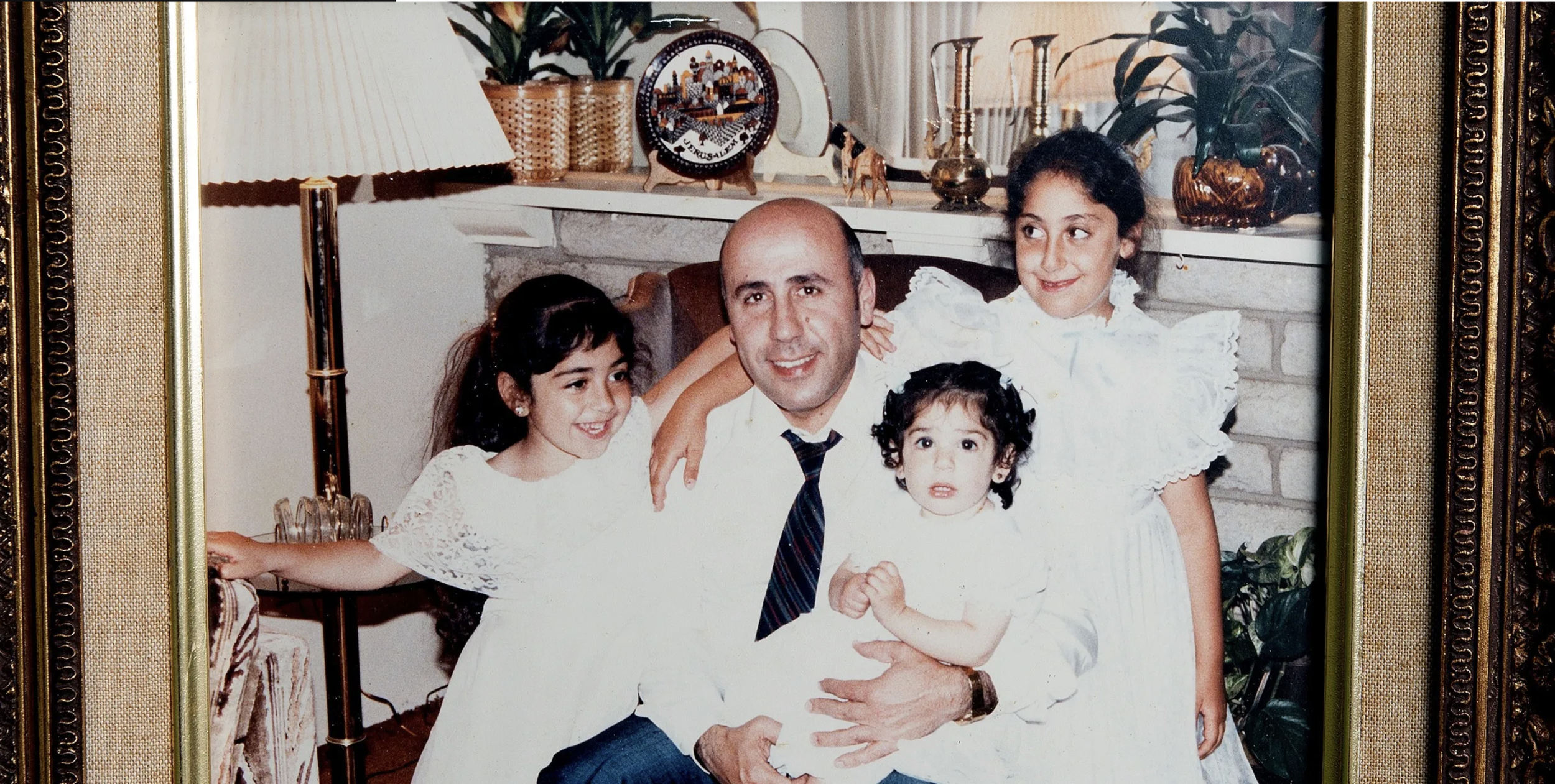
Alex and the kids
Alex Odeh was killed because of his advocacy for an encompassing, loving idea: one of peace and justice and reconciliation in Palestine and beyond. His assassins were motivated by hatred and erasure, and those who have facilitated their escape from justice, by cowardice and omission.
Alex lived a life of meaning, of humanity, of service to community, and for a greater, more noble ideal of what people can be. And, for that, his life was taken, over forty years ago.
Palestine was the land of Alex’s birth. It has always been a crossroads for empires and peoples, a place where civilizations rose, and kingdoms fell, where the palimpsests of history have been written and scratched out, time and time again, never fully erased, each era, each epic leaving its mark upon that which followed.
Yet, for Alex and his compatriots, descendants of all the peoples who inhabited the land: the Canaanites, Egyptians, Philistines, Hebrews, Assyrians, Babylonians, Greeks, and Romans, Byzantines, Arabs, Franks, Mongols, Armenians, and Ottomans, Palestine was also, simply, their home. It was the place they were born, where they studied and worked, where they raised families and honored those who passed. It is where one could look back across time, then gaze into the future, confident that, as it was for forebearers over countless generations, their place in Palestine was eternal.
Alex was born into a Roman Catholic Arab family in Jifna, a village in central Palestine, in 1944, four years before the catastrophe, or Nakba, that devastated Palestinian society in 1948. He grew up in a country whose heart was torn from it, where the great majority of its citizens were made refugees living either on the 22% that remained in Arab control after armistice lines were drawn in 1949, in exile in surrounding countries, or further afield. Limited opportunities for higher education in Palestine took Alex to Cairo, when a new tragedy struck: the 1967 War that brought Israeli occupation to Jifna, and the portions of Palestine that had been spared it before. Though his university was less than 300 miles away, Alex was forbidden from returning – his right to his ancient land stolen away.
To many in the West, Palestinians were seen as only refugees, exiles, or a people whose identity was “undefined.” This was a small portion of reality, however. Too often overlooked was the depth of history, culture, and connection that Palestinians have to their homeland wherever they were. In many cases, this omission was deliberate, a means to make obscure or strip Palestinians not only of their homes, but also their primordial ties to the land.
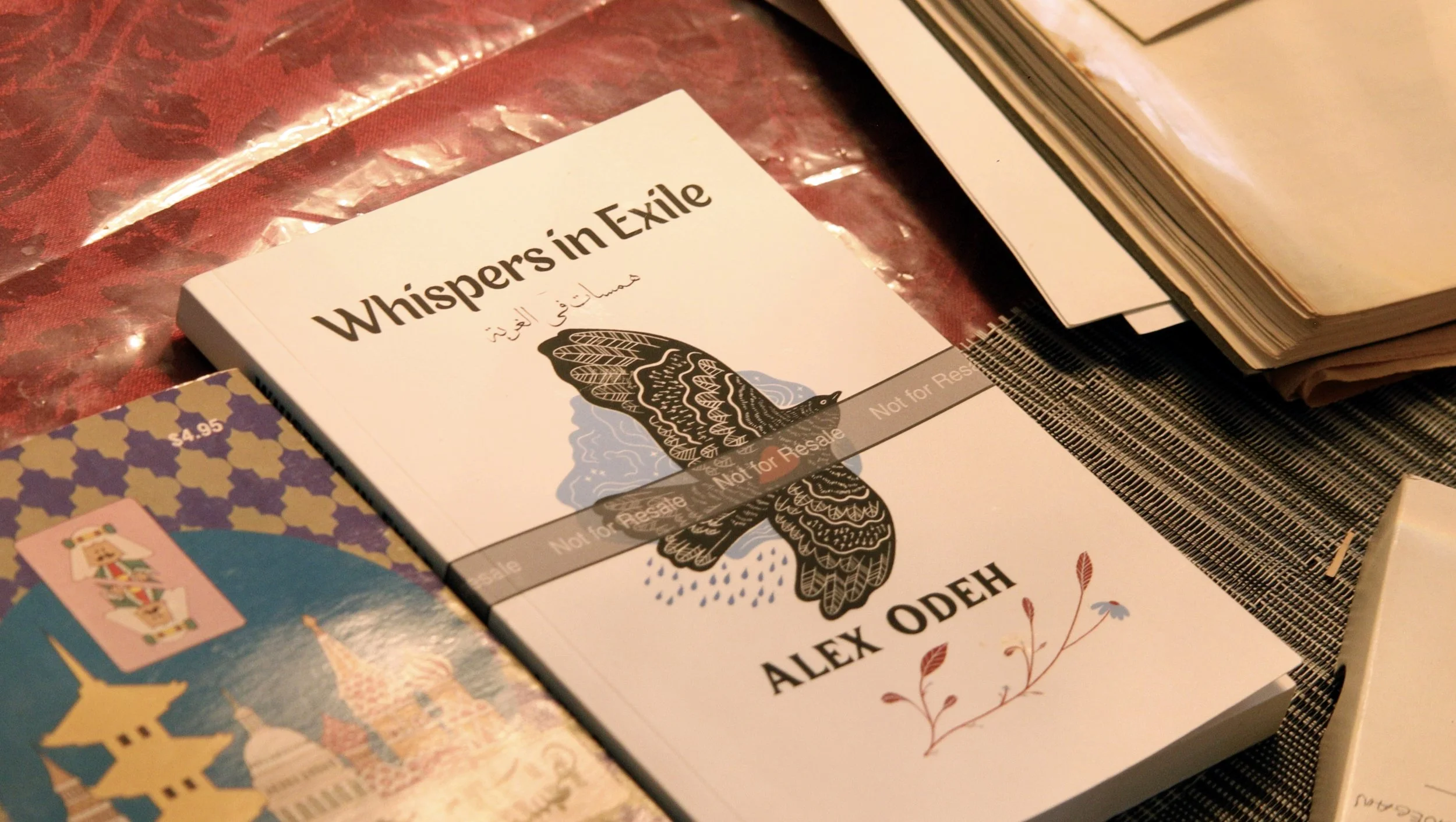
As so many others, Alex did not allow the loss of Palestine to crush his spirit. A gentle, soft-spoken man, he endeavored to resist through his mind and creativity. Alex completed graduate studies at Cal State Fullerton and taught as a university lecturer, always maintaining an openness of spirit and hope, but also, of wry, ironic humor and reflective criticism. Alex’s collection of poetry and essays Whispers in Exile (Hamsaat fil Gharba) expresses both tenderness:
My homeland in my heart
like a flower of love,
how beautiful it is, fresh,
tender, fragrant, rejecting all the laws of aging
and defiance:
I could bear to be slapped and slapped…But I will not allow myself to be defeated.
Throughout, Alex expressed the necessity for self-reflection and analysis, not adhering to pieties or reaction, but thinking critically about what is needed to achieve justice, to be true to one’s convictions, yet also open to possibilities and challenges:
Some people want to continue living the
yesterday they lost.
And others want to be reborn
Those are the disobedient and rebellious people.
Alex’s rebelliousness was expressed constructively, through coalition, organization, and advocacy across ethnic, racial, and religious lines. His role as the West Coast regional director of the American Arab Committee (ADC), an organization dedicated to preserving and asserting the civil rights of Arab Americans while also telling their stories, was well suited to Alex. He regularly reached out to political figures and other civil rights organizations and was enthusiastic about Jesse Jackson’s inclusive, 1984 campaign for President. Alex believed in communication, discussion, and dialogue, and met regularly with groups – including Jewish organizations – to both express his views and to understand their own. On the day of his murder, in fact, he was scheduled to speak at Congregation B’nai Tzadek, a local synagogue, conveying a message about the need for justice in Palestine and the recognition that Judaism and Jews were not synonymous with Israel or Zionism.
At the time, there were few voices from the Arab American community that the media would reliably call on to speak about matters of importance to them, and Alex, both because of his position with the ADC, as well as his collected demeanor, was among them. Too often, media portrayals of Arabs, especially Palestinians were selective and negative: either terrorist, uncultured, wealthy oil sheikh, or jihadist fanatic. Alex was a counterpoint to those crude stereotypes. Recognizing the power of the press, he made himself regularly available for interviews and discussion – all in the hopes that peaceful presentation of the wrongs that had been imposed on Palestinians would eventually lead to justice.
The evening before his assassination, Alex was interviewed by an ABC affiliate station in LA about the hijacking of Achille Lauro, an Italian cruise ship, by Palestinian militants that resulted in the murder of Leon Klinghoffer, an elderly Jewish American passenger in a wheelchair. During the more than 40-minute interview, Alex explicitly condemned the killing and hijacking. He furthermore explained that this operation was led by renegades who did not represent the position of the Palestine Liberation Organization or of its leader Yasir Arafat, a man who Alex stated had long sought peace talks. Yet, the station aired only a tiny extract of that interview, a clip where Alex explained that he could understand the frustrations and hopelessness that might have driven the hijackers to do as they did. Erased was all of the context that led to this tragedy, Alex’s empathy for the victim and decrial of this violence, as well as Palestinians’ legitimate struggle for their rights to justice. Instead, the media reduced his words to a rationalization of Palestinian violence, an omission that proved fatal.
The following morning, October 11, 1985, Alex Odeh was killed when a pipe-bomb planted the night before exploded as he opened the booby-trapped door of his office in Santa Ana. Given the history of harassment and threats by the Jewish Defense League (JDL), a militant Zionist organization,that Alex and other Arab American leaders endured over the years, the killing was immediately understood to be an act of domestic terrorism. Politicians and leaders, including President Ronald Reagan and members of Congress, sent their condolences to Alex Odeh’s family and condemned the killing. Both local police and the FBI investigated, and they determined that the bomb was the likely work of JDL operatives who had fled to Israeli settlements in the weeks that passed Suspects were named, and while they lived openly in Israeli society, they were not extradited or brought to justice. According to several sources, the US State Department and Department of Justice have, under the pressure of US and Israeli leaders, stepped away from the case, likely in hopes that Alex Odeh, and the struggle for justice, would be eventually forgotten. It wasn’t.
The Arab American community was profoundly shaken by Alex’s murder. My father, Awni Said Rayyis, a community leader in Los Angeles, counted Alex as both a friend and collaborator. They shared many joyful moments, but also the strain of turbulent times, like Alex, he also threatening late-night phone calls and harassment by JDL activists.
The mid-1980’s were marked by anti-Arab and Muslim rhetoric following the Iranian revolution, the Israeli invasion of Lebanon and massacres of Palestinian civilians, the bombing of the US Marine base in Beirut, threats by the JDL, and perhaps more ominously, US government surveillance at home.
The assassination of Alex Odeh only confirmed the fears of many. Despite that, the work of community, organizing, advocating, and educating, was ongoing. My parents, Palestinian, both, my dad, Arab and Muslim from Gaza, my mom Armenian and Christian from Jerusalem, were among those who persisted. Like Alex, my dad, blessed with a congenial personality, periodically appeared on television, explaining the Palestinian position and its struggle for justice. The last time he did so was in spring 1988, a few months after the breakout of the first intifada, when Palestinian society rose up in defiance of Israeli occupation. General strikes were called, and young people armed with no more than rocks in hand confronted heavily armed Israeli soldiers. Inevitably, hundreds were killed, thousands more were beaten mercilessly or imprisoned. During a rare moment of establishment revulsion at Israeli brutality, my dad was able to describe the situation as it was, with fewer filters than Alex had faced three years before. One afternoon, May 2, 1988, after my dad returned from lunchtime protest at which a JDL member had allegedly threatened him, a gunman shot and killed him outside his office. While his murder was not as obviously an act of terrorism as was Alex’s – there was an arrest and conviction, supposedly for robbery that resulted in murder (nothing was stolen) – serious questions remained about the killer’s motives, or if he received incentives for committing the crime. At my dad’s funeral, Norma Odeh, Alex’s widow, embraced my mother with the sort of sorrowful understanding that only two women who suffered such sudden, violent loss, might have.
The importance of the work of Alex and others continued to be felt in years following. The intifada raged in Palestine in the late 1980s to early 90s, and the first Gulf War, which, ironically was launched in support of one Arab country, Kuwait, invaded by another, Iraq, stirred up anti-Arab sentiments. If ever there was a need to affirm Alex Odeh’s message of harmony, understanding, and peace, it was then. Recognizing the significance of Alex’s work, Algerian American artist Khalil Bendid approached Norma Odeh with a proposal to create a memorial sculpture. Receiving her blessings, he turned to potential funders who might contribute production costs, first among them the beloved DJ and television host, Casey Kasem. As a widely recognized Arab American voice in media, Kasem leveraged his cultural influence to amplify the importance of the Alex Odeh memorial. Beyond helping organize fundraising and coordinating with the ADC, his involvement sent a powerful message: that Arab Americans could publicly honor their leaders, assert their presence in civic life, and inspire solidarity across communities..
The steering committee officially offered the bronze sculpture as a gift to the City of Santa Ana, and the City Council voted unanimously to accept it for public display in front of the Main Library. The Alex Odeh Memorial Stature was unveiled in front of the public library on April 11, 1994. Over 500 attendees gathered for the event, which featured a wide range of voices, including elected officials, community and civil rights leaders, religious figures from Muslim, Christian, and Jewish communities, Odeh’s family, and the sculptor who created the statue.
The statue presents a larger-than-life Alex Odeh seated in quiet dignity, holding a book in one hand and a dove in the other. These elements speak not only to learning, reflection, and thoughtful contemplation, but also to his enduring commitment to dialogue and peace. Honoring a city with a population that is 85% Latino three commemorative plaques, in English, Spanish, and Arabic are mounted to the pedestal. Despite these positive messages, the event was met by hatred, as JDL members loudly protested, hoping to intimidate those present and Santa Ana city officials.
Over the years the statue was attacked several times, mostly splattered with red. In 2020, the dove was physically broken off and stolen from the sculpture. The reasons for that desecration were unknown. It was later recovered by police and restored to the monument. In this context, the dove has come to carry meanings beyond its traditional symbolism of peace and return, those of resistance, repair, and renewal.
This chronicle about Alex has been written in the past tense, but, unfortunately, the issues that he spoke about and worked to resolve are very much part of our present. The cruelty, the racism, the inhumanity that Alex and others decried continue with evermore brutality. One might be forgiven into thinking that the cause for justice in Palestine is lost and that the forces against it are too powerful to defeat. Yet, we are also at a time of greater understanding, of magnified solidarities, of ever expanding appreciation for the common cause that so many around the country and around the world struggle for. In the four decades since Alex’s killing, people across the United States—Latino, Indigenous, African American, North African, European, Asian (from South, Southeast, East, and West Asia), and Pacific Islander communities—have stood together to speak out against injustices in Palestine, Syria, Iraq, Iran, Yemen, across Africa, and throughout the Americas, including within the United States itself. While it is inevitable that, in a public square that people pass through on a daily basis, the meaning of the statue might go unnoticed by many, the Santa Ana plaza that hosts Khalil Bendid’s sculpture has become a gathering place for celebration and protest, particularly since the genocide in Gaza that started in October 2023. Latin and Arab, especially Palestinian, coalitions are thriving. This year, Santa Ana, a city that is 85% Latino, next to another city, Anaheim, with a large Arab population, is hosting a suhour – a pre-dawn meal during the month of Ramadan, in which Muslims fast during the daylight hours. Another initiative, taco trucks at every mosque, is now in its tenth year. How fitting that a message of harmony by a Christian Palestinian, lives on, finding new expression for the Muslim community in a Latin city forty years after he was taken from us.
The spirit behind this peace work was what drove Alex’s work 40 years ago. It is one of peace and renewal, of devotion and blessings. Blessed are the Peacemakers. To spread this spirit, the dove, once absent, then restored, is being sent on a mission to remind people of the principles that Alex stood for, to reflect on what can be accomplished through perseverance, through community, and through love.
Dove of Peace: A beautiful kiss
carried by one heart to another
(Alex Odeh, Whispers of Exile)